Monitoring Country

Bats
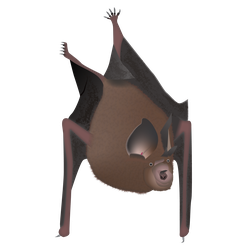
Bats are the only mammals with wings that can truly fly (not just glide). Most bats are nocturnal. Some bats roost in large colonies while others live alone, and roost sites can be in caves, tree canopies, tree hollows, under bark, in old bird nests or in the roofs of houses.
Many bats don’t have good eyesight, so they make high-pitched sounds to find their way around and hunt in the dark. This is called echolocation. Humans can’t hear most of the ultrasonic (high-frequency) sounds that they make.
There are more than 90 species of bat that are native to Australia. They are generally divided into two major groups:
- Megabats (like flying foxes) are larger, mostly eat fruit and generally don’t use echolocation
- Microbats are smaller, use echolocation and mostly eat insects
Where they are
Conservation Status
In Australia, 10 bat species are listed nationally as Threatened and another 2 species are listed as Extinct.
Threats
Some of the key threats to bats include:
- Unhealthy Country or lost habitat caused by:
- land clearing
- mining
- wrong-way fire
- Death or injury from fence collision
- Disease
- Climate change

Bats can carry diseases. Avoid handling or touching bats or their faeces. Anyone bitten or scratched by a bat should seek medical attention immediately.
You can monitor bats to better understand:
- Where they do and don’t live
- How many live on Country
- How well management of Country and bats is working
If you monitor the same place at the same time every year, you can see if there are changes to bats on Country.
The following is a list of some standard monitoring methods for bats. If you are interested in a particular species, have a look at the species page to find out which survey type is most suitable.
Any time you do work that might disturb or interfere with native animals and vegetation, particularly threatened species, you need to check with the state authorities to see if you need any approvals, such as scientific licences or animal ethics committee permits.

- Biodiversity – what microbat species live on Country
- Species Richness – how many different microbat species live on Country
- Presence/absence – if and where microbat species live on Country
You can learn more on the Audio Recording Units (ARU) page and in the Environmental Monitoring Method: Bat Monitoring with Audio Recording Units (ARU
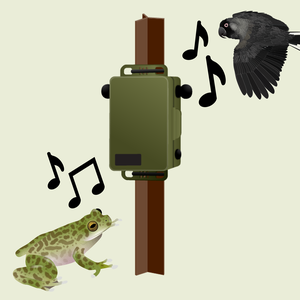
Microbats can be monitored with specialised ARUs, sound recording devices that have high-frequency microphones. These specialised ARUs are designed to pick up and record ultrasonic calls and save them to a memory card.
This method can be used for monitoring lots of different microbat species at once, or can be used to target specific species, like the Ghost Bat.
Using it the Right-way
The following information about the bat species you are interested in will help guide whether ARU monitoring is the right choice:
- can be identified from an acoustic recording
- frequency range of calls
- similarity of calls to other bat species
- availability of a call reference library
This information will help you decide when, where and how you do the ARU monitoring:
- general biology and ecology, including migratory and breeding behaviour
- preferred feeding and roosting habitats
- high activity periods – migratory patterns and time of night, season or year.
Ethics
Install equipment quietly at roost sites to avoid scaring bats into flight during daytime conditions.
Avoid or install equipment quietly at active maternity roosts – this is usually during late spring or early summer when female bats are pregnant or carrying young.
Timing
Generally plan to do bat ARU surveys in warmer seasons when most bats are active. Also consider the type of bat:
- insectivorous bats: do the monitoring in warmer seasons when there are lots of insects and bats are most active
- cave-swelling bats: do the monitoring in winter when some cave-dwelling bats are reliable found in colonies in their winter cave roosts
Postpone the survey if there is predicted rain (damage ARUs), high wind (masks bat calls) or unseasonably cold temperatures (bats are less active).
Plan to do leave ARUs at each site for 3-5 nights.
Location
Choose habitats where there could be bat activity, such as roost sites, foraging/feeding areas or nearby water sources. If you interested in lots of different species, put ARUs in different habitat types. Try to have the same number of sites/ARUs for each major habitat type. If you are targeting a specific species, put ARUs in the preferred habitat.
At each site, put the ARU in a clear, open flight path, like a track, creek, gorge or gap in the tree canopy. If your site has a cave mouth, put the ARU 10-20 metres away (not in the cave mouth). Also choose the location based on the type of bat:
- fast, high-flying bats: put ARUs in clear/open areas at large lakes/pools/rivers or on top of hills/outcrops
- bats that hunt along tree lines: put ARUs along the edge of thick bush and clear areas, like firebreaks, tracks or creeks
- slow, agile bats: put ARUs inside flightpaths under tree canopy
Primary sources
This landing page was developing using the following sources:
Primary sources
This landing page was developing using the following sources:
- Australian Museum. Australian Bats
- Queensland Government. About bats
- Australasian Bat Society Bat Fact Sheets
- McKenzie & Bullen (2009) The echolocation calls, habitat relationships, foraging niches and communities of Pilbara microbats. Records of the Western Australia Museum, Supplement 78.
- DCCEEW (2010). Survey guidelines for Australia’s threatened bats.
Tools and resources
- Australasian Bat Society’s BatMap distribution maps
- National survey guidelines for Australia’s threatened bats
Webpage version: GA-250526