Monitoring Country

Mammal Spotlighting
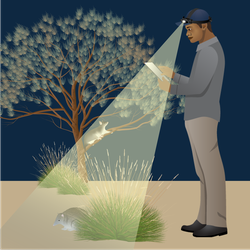
Spotlighting surveys are a useful tool for monitoring nocturnal mammals, like possums and wallabies.
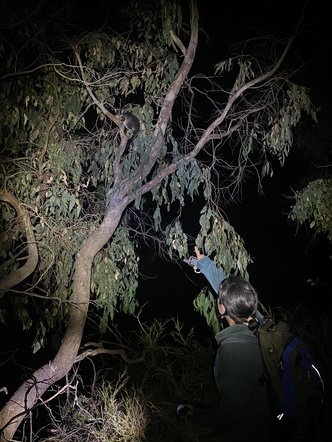
Spotlighting involves looking for animals at night using bright lights. It usually involves walking or driving slowly along a line transect (a path or track) and carefully looking for animals in trees or on the ground.
Why Are They Useful?
Less stress for animals: Spotlight surveys don’t involve catching and handling mammals. Animals are often stressed if they are caught and handled by people.
Quick and flexible: Spotlighting surveys don’t require much effort and can be done without much equipment or complicated planning.
What can mammal spotlighting surveys monitor?
Mammal spotlighting surveys can monitor the mammals that are active at night on Country. They are commonly used to monitor nocturnal species like:
- Possums
- Bettongs
- Wallabies
- Kangaroos
- Gliders
- Koalas
Have a look at the How We Check On Things page to find out how you can use spotlighting to monitor other animals like frogs, some reptile (geckoes, pythons) and some bird (owls).
What can you learn?
- Biodiversity – what species live on Country
- Species Richness – how many different species live on Country
- Presence/absence – if and where species live on Country
- Activity - how many of each species were seen during the survey. This can be used as an indicator of how large the population might be.
- Population size – how many of individuals live on Country. Only certain types of spotlighting surveys (e.g. line transects) can be used to estimate population size.
What can’t you learn?
- Animal health – because you are not trapping or handling the animal, you can’t tell much about it’s health
- Spotlighting can’t always tell you which species aren’t living on Country. This is because you might not see all the species on the night you do your survey, or they might change their behaviour because you are in their habitat.
Using mammal spotlighting the Right-way
Timing of surveys
- Nocturnal mammals need time to wake up and become active, so spotlighting surveys should always start at least 60 minutes after dusk.
- Avoid doing spotlighting survey when it is windy or rainy, or if the vegetation is very thick because it can be hard to see the animals in these conditions.
- Temperature can affect how active the animals are – if it is unusually hot or cold for your area, it probably isn’t a good time to do the survey.
Using spotlights
- Spotlighting surveys are best done with a bright headtorch. It is recommended that headtorches for spotlighting have:
- minimum of 300 lumens
- focusing lens/adjustable beam
- ability to swap out rechargeable batteries in case it runs out of power during the survey
- If you plan to do spotlight surveys from a vehicle, and you want to use handheld spotlights:
- 50-75 watt light bulbs (100 watt lightbulbs are too bright and will temporarily blind animals)
- Adaptor cable to charge from the car’s cigarette lighter port
- Avoid shining the bright headtorch or spotlight at an animal for a long time so that it isn’t blinded. Once the animal has been spotted and identified, move the light away from the animal. Red lights and dimmer switches can be used for extended observation but shouldn’t be used when searching as you will have reduced visibility.
Mammal spotlighting with line transects
Nocturnal mammals can be monitored by spotlighting along line transects. This data can be used to estimate population sizes or activity indices. These surveys can be used to monitor lots of different species of nocturnal mammal, or can be used to target a specific species of mammal.
Usually these surveys are done on foot, but cars be used for some species of wallabies and kangaroos.
If you are interested in finding out where a specific species lives, then your sites can be in their preferred habitat. If you are interested in all of the nocturnal mammals on Country, then you sites need to be spread across all of the major habitat types.
To estimate population size, there need to be lots of detections of each species, the transects need to be surveyed multiple nights in a row, and the transects need to be in all of the major habitat types found on Country. To see if there are changes in the population over size, the survey should be done every 1-2 years at the same time of year or in the same season.
You can learn more about using this method in the Environmental Monitoring Method for Mammal Spotlighting Surveys with Line Transects.
Koala monitoring with line transects
Koalas can be monitored by spotlighting along line transects to estimate population sizes, activity indices or presence/absence of Koala populations. Unlike most other Australian mammals, this survey can be done at night with spotlights or during the day when Koalas can be seen resting in trees.
You can learn more about using spotlighting to monitor Koala on the Things We Care About page and in the Environmental Monitoring Method for Koala Monitoring with Line Transect Searches (in development).
Primary sources
This landing page was developed using the following sources:
- Department of Sustainability, Environment, Water, Population and Communities (2011). Survey guidelines for Australia’s threatened mammals. Commonwealth of Australia. https://www.agriculture.gov.au/sites/default/files/documents/survey-guidelines-mammals.pdf
Tools and resources
- EMSA standardised survey methods: Fauna Ground Counts Module
Webpage version: GA-JH-GA-140426
Tools and resources
No additional tools or resources found.