
Monitoring Country

Night Parrot
 Critically Endangered
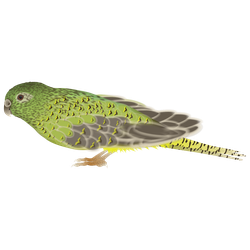
The night parrot is a small, nocturnal bird that mostly lives on the ground. It is cryptic, which makes it hard to monitor. It was thought to be extinct until it was rediscovered in 2013. Some night parrot locations are kept secret to protect the birds.
| Aboriginal Name | Language Group |
|---|---|
| Ngarrijirri | Manyjilyjarra |
| Kurrual Kurrual | Martu |
| Kulkurru | Ngururrpa |
| Pullen Pullen | Maiawali |
Species Records
Use the + - Zoom controls to select an area
Where they are
Night parrots are a small parrot with:
- Long wings and a short tail
- Bright green body and yellow belly
- Black and yellow pattern
Young night parrots are grey and change to green as they get older.
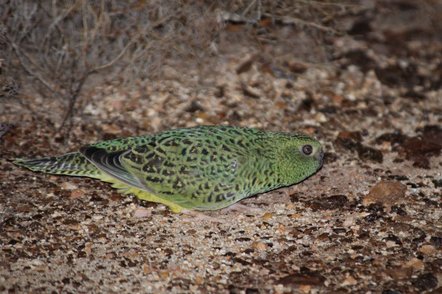
Night parrot. Credit: Nick Leseberg.
Calls
Night parrots have many different calls. You can hear some of their calls by clicking here.
Night parrots start calling about 30 minutes after sunset, and they only call for a few minutes. They start calling again 30-90 minutes before sunrise, and can call for 10-15 minutes.
Night parrots often call more after rain.
Conservation Status
- NSW - Extinct, NT - Endangered, Qld - Critically Endangered, SA - Endangered, WA - Critically Endangered
The night parrot is now listed nationally as Critically Endangered (since 2025). This is because there are very few of them left (less than 50 breeding adults in each population) and their numbers are likely still going down. There is conservation advice for the night parrot, which helps people know what management, monitoring and research is needed to best look after the night parrot.
Threats
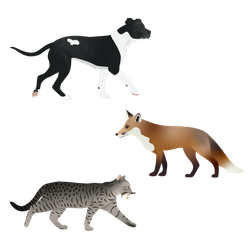
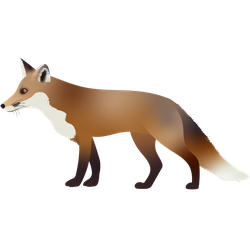
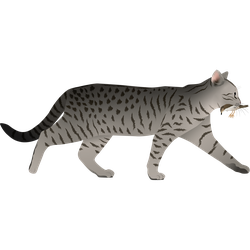
- Predation by feral cats and introduced European red foxes
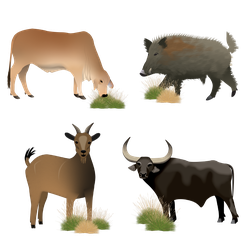
- Loss of habitat caused by livestock and feral herbivores like cattle and feral pigs
- Wrong-way fire (bad fire regimes - more often, hotter, bigger)
- Weeds (buffel grass changes the habitat night parrots need)
- Climate change (hotter temperatures and changing rainfall)


- Where night parrots do and don't live
- How many night parrots live on your Country
- How well management of Country and night parrots is working
If you monitor the same place at the same time every year, you can see if there are changes to night parrots on Country.
Any time you do work that might disturb or interfere with native animals and vegetation, particularly threatened species, you need to check with the state authorities to see if you need any approvals, such as scientific licences or animal ethics committee permits.

-
If and where night parrots live on Country
-
Estimate how many night parrots live on Country (this involves some advanced statistical analysis)
-
See changes in where or how many night parrots are on Country (if you monitor the same places over many years)
You can learn more about using ARUs (Song Meter 4) in the Environmental Monitoring Method: Night parrot Acoustic Monitoring - Song Meter 4 (SM4)
You can learn more about using ARUs (Song Meter Mini) in the Environmental Monitoring Method: Night parrot Acoustic Monitoring - Song Meter Mini
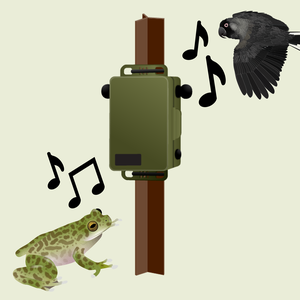
Autonomous Recording Units (ARUs) can be used to monitor night parrots on Country. These are recording devices that can be set to record sounds over time and save them to a memory card. You can then listen to the recordings to identify species by their calls. Setting up the devices and putting them out on Country is fairly easy, but devices can record a lot of data (up to hundreds or thousands of hours) depending on the settings. Be mindful of how much data you record by adjusting the settings.
The best way to check for night parrots is by listening for their calls using ARUs. Night parrots are cryptic, so most other methods won’t work well (if at all). Put ARUs in areas where night parrots sleep or eat. Plan to do a targeted survey when night parrots are active and calling:
- Check when it has its breeding season
- Check which times of day and/or night they are active. Night parrots usually call:
- About 30 minutes after sunset (for a few minutes)
- 30 – 90 minutes before sunrise (for about 10-15 minutes)
- Night parrots also call after a good rain
-
Where night parrots live:
-
Occupancy - the proportion of sites occupied by a species
-
Changes over time - are species being detected at the same sites every year, or are they disappearing from some and/or appearing at other sites?
-
Habitat preferences - does the species only occur in particular habitats?
-
-
Detection frequency - how often are they being detected in an area?
-
Behaviour - what are they doing in the photos?
-
Activity - you can know when they are active or passing through areas
-
This can also be used as an indicator of how large the population may be
-
-
You can collect other data from seeing night parrots in an image. You might be able to identify their age, sex, group size, or health (skinny or fat)
You can learn more about using camera traps in the Environmental Monitoring Method: Landscape Scale Camera Trap Monitoring
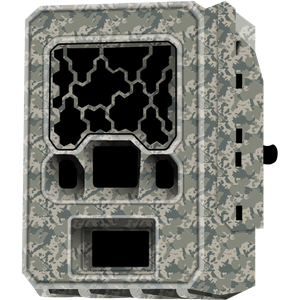
Camera traps can be used to monitor night parrots on Country. They can be set to automatically take photos or videos when an animal passes the camera. You can make your monitoring more efficient and cost effective by monitoring multiple species (including native and introduced species) with this method.
You will need to buy good quality remote cameras, but not much training is needed for deploying cameras or identifying species in the images. Images can also be processed first with the use of artificial intelligence (AI) tools, which can be useful when you have large numbers of images.
Night parrots are not usually or easily detected on cameras, but it is possible if you have suitable habitat within their known distribution area.
- Put cameras in their preferred habitat (spinifex)
- Night parrots are thought to have large home ranges, so put cameras at least 1 km apart
- Choose sites that are good for camera trapping (open enough to take photos, easy to get to, not in areas prone to flooding)
- Set up cameras to face an obvious path that night parrots use. Angle the camera down the path, so that you increase the amount of time the camera has to take pictures as night parrots pass by
- Night parrots have a medium-sized body, so should easily trigger the camera sensors. You can use the standard camera trapping set up (height of 30 - 40 cm from ground) to monitor them/alternative height or set up e.g. in tree, lower or higher etc.
- Whenever possible, double check image classifications (including images with “nothing” in them), especially when using AI
Primary sources
This landing page was developing using the following sources:
- Ngururrpa Rangers et. Al. (2024). Potential threats and habitat of the night parrot on the Ngururrpa Indigenous Protected Area. Wildlife Research 51(10).
- Atlas of Living Australia. Pezoporus occidentalis (Night Parrot). Accessed: March 2026
- Department of Climate Change, Energy, the Environment and Water (2025) Species profile and threats database (SPRAT): Pezoporus occidentalis (Night parrot). Australian Government.
- Department of Climate Change, Energy, the Environment and Water. (2025). Conservation advice for Pezoporus occidentalis (night parrot). Australian Government.
- Department of Biodiversity, Conservation and Attractions. (2024). Guidelines for determining the likely presence and habitat usage of night parrot (Pezoporus occidentalis) in Western Australia. Australian Government.
Webpage version: CM-GA-JH-060426